Wednesday, October 14, 2015

Review of Bone # 2 : "The Great Cow Race"

The first book of this series, Out From Boneville, which I reviewed recently, was a fast-paced, exciting read with lots of action and intriguing plot lines. In comparison, "The Great Cow Race" runs at a turtle's pace and allows little plot surprise.

The story is good enough for mild entertainment, and keeps readers interested in continuing the series, which I certainly was. I think my students approach it like another episode in a TV series, it just moves the whole plot forward, slightly.

As for plot content:

- Phoney Bone tricks all the villagers into placing a false bet on a "mystery cow" so that he can make great wins at the town cow race. He gets his due reward by losing heavily and being kicked out of the town.

-Fone Bone continues to be in love with Thorn, and begins writing her love poetry.

Mature aspects:

-Thorn flirts with a young man who is more interested in showing off his muscles than wearing a shirt. He eventually brushes Thorn aside for another girl. The scenes are very mild, and meant to be slightly humorous. (Fone Bone is compared to the young, muscular man).

-Other parents have complained that some characters are smoking in the story (the dragon smokes a cigar), that some scenes occur in a bar, and that characters engage in gambling. My response is that the main characters, Fone and Thorn, do not engage in these activities. In some ways, the dragon "smoking" is meant to be an off-hand joke. The scenes that occur in the bar are contextual; there are no restaurants in Boneville, and the main characters--Fone and Thorn--are shown eating and drinking tea. Phoney Bone's gambling always proves itself disastrous, so its presence is more moral than than condoning.

My only true complaint with the series so far are the subtle sexual innuendos, the suggestion of Thorn being attractive because of her sexual appeal. I think the flashes of too much skin takes away from her strength of character and demeans her. It would be better if (boys) reading the story could admire her for her.
  

Friday, June 26, 2015

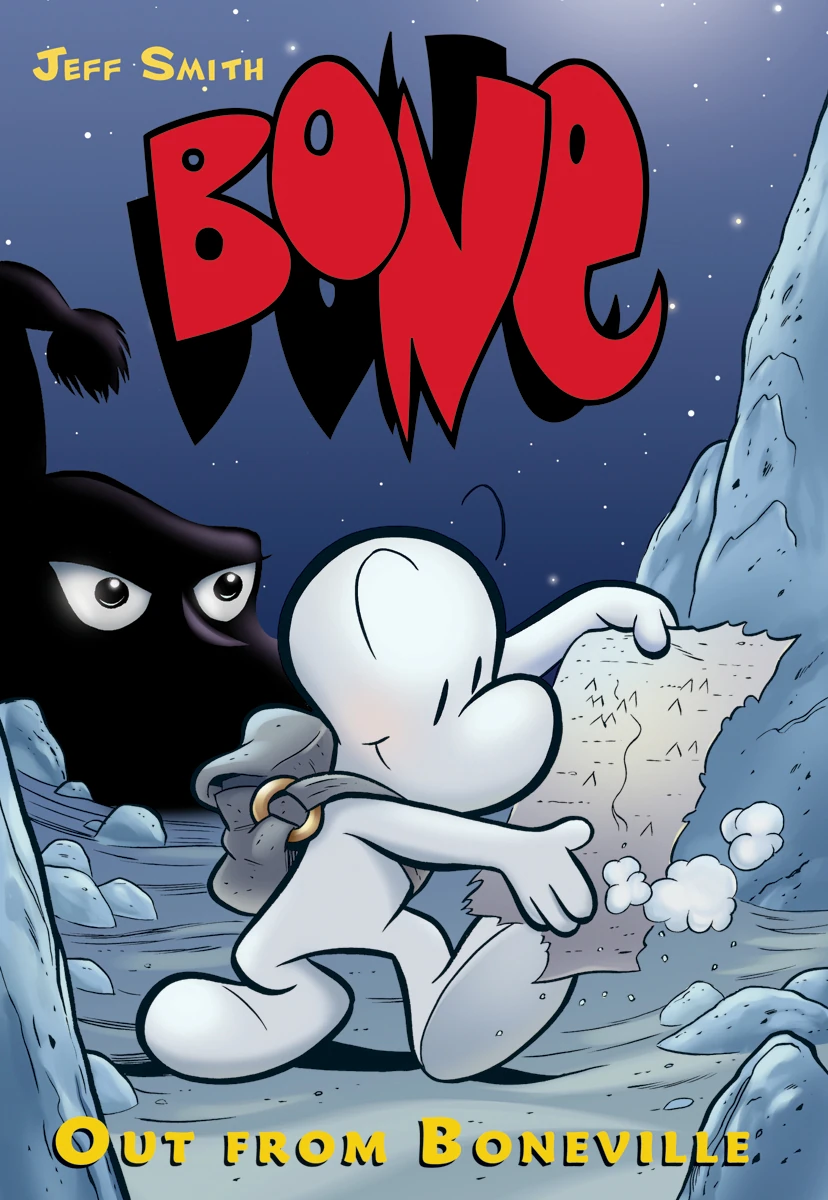
Review Bone # 1 : Out From Boneville


"Bone: Out From Boneville" was a quick and easy read that had an amusing plot line and great graphics.

This series is extremely popular with my elementary aged students, especially G. 2-7 boys,  some girls are also interested in the series. Its popularity stands next to the Amulet series, which has more female followers.

I liked all the characters, especially the moral "Fone Bone", who is the main character. He plays foil to his friends Smiley Bone and Phoney Bone, who are often up to no good.

What is he? That was also a question I had in mind. Jeff Smith originally drew his characters with a telephone receiver as reference. These eventually developed into the
"bones" we see today. Though exactly what they are is not really relevant.

My main hesitation with the story is Fone Bone's romantic interest in Thorn, a human girl. There are several showy images of her legs, and one a slight show of her breasts, as her clothes are titillatingly ripped off by rat creatures. At another moment, she invites Fone Bone to go bathing with her and it's implied that she is naked, but he willingly jumps into the pond with her and swallows the soap. It's a little bit weird, but it's meant to come off as funny because he is well, a small strange creature, and she is a regular human being. There is one image that is too showy, though, in my opinion, and it almost makes me hesitate to recommend the book to young boys because of the focus on Thorn's body.  

The evil rat creatures are frightening looking, but their funny dialogue off-sets their grotesque appearance, making them seem mostly ridiculous.

All in all, I enjoyed it. It's unfortunate for the one image, or else I would wholeheartedly recommend it.


Wednesday, May 27, 2015

Review: Percy Jackson: The Lightning Thief

I just finished reading my first book from the Percy Jackson series. Entertaining at times, predictable at most (from an adult's perspective), but it's definitely an accessible read for G.5-9 readers.

Great issues dealt with: ADHD, dyslexia. The main character has these disabilities, and although they do provide some difficulty for him in succeeding with his mission, they don't impede him, or let him feel like he is not good enough to complete the task.

Not so great issues dealt with: marital problems. Although I can imagine a G. 5-9 reader would skip over this part, Percy's mother's relationship with "Smelly Gabe" is dysfunctional and unconvincing. The argument is that she must live with "Smelly Gabe" in order to protect Percy from being detected by monsters. But I think the real reason is entertainment value; Gabe is basically a comical relief punching bag. Percy's mother "kills" him in the end, though a close reader might miss this (she petrifies him by showing him Medusa's head). Problematic on some levels.

Writing Style is quick, focused, witty, and fast-paced. The plot was forgivingly predictable because I was not bored as I was reading, even though I knew what was going to happen. The characters are well-developed and Percy is so well-shaped I felt like I could meet him.

Thematic issues: to present the Greek gods as gods, Riordan had to come up with some clever ways of incorporating them into our Western culture, while remaining politically correct. The Greek religion is presented as something "older" than Christianity (he compares the Greek sign to the sign of the cross). The Greek religion does, however, supersede Christianity since Percy prays only to his father-greek god for help.

When the main characters arrive in the underworld, Percy expects to find the pearly gates, but the underworld looks more like "a cross between airport security and the Jersey Turnpike." As a Christian reader, I always hesitate about any re-interpretation of the Greek underworld. Objectively, it is simply not heaven, and cannot be since it is ruled by Hades, who is generally described as evil, and not God, who is good. So it is difficult to attempt to compromise, as Riordan does, the two world views. But he manages to find a way:

"But if he's a preacher," I said, "and he believes in a dif-ferent hell... ."
 Grover shrugged. "Who says he's seeing this place the way we're seeing it? Humans see what they want to see. You're very stubborn—er, persistent, that way."

The answer is that some humans "see" a different heaven or hell according to their beliefs. In this way, Riordan accommodates all worldviews of the underworld. All, except, those who disagree with relativism (which is everyone who has a belief).

My feelings about the book are mixed, but I will keep it on the shelf. It's a fun adventure that is engaging, imaginative, and fun to read. It doesn't offer much more than that in terms of life lessons or virtues.


Favourite quote:

"The River Styx," Annabeth murmured. "It's so ..."
 "Polluted," Charon said. "For thousands of years, you humans have been throwing in everything as you come across—hopes, dreams, wishes that never came true. Irresponsible waste management, if you ask me."


Monday, May 11, 2015

Storybooks about Art and Artists


Laurence Anholt's picture book series, "Anholt Artists," tells the stories of art and artists from a child's perspective. In his "The Magical Garden of Claude Monet", we follow Julie as she visits Monet's enchanting garden. The story is based off a real Julie who frequently visited with her dog, "Louie." 
Julie was the daughter of great impressionist Berthe Morisot, and niece of Edouard Manet. And her pet dog was a gift from another famous impressionist, Renoir.

The illustrations of the book mix interpretations of scences from Monet's life, with real presentations of his paintings. There is one spectacular fold-out centre-piece that depicts Monet's lily pond--it garnered a real wow from the students!


Check out the other books in the series:

Leonardo Da Vinci


Edgar Degas


Pablo Picasso


Vincent Van Gogh

Anholt Artists website: http://www.anholt.co.uk/anholts-artists/


Thursday, April 2, 2015

Books for Easter


A recent article in Maclean's confirmed for me the need to read religious and spiritual books to children. In "The Science is in: God is the Answer" Brian Bethune and Genna Buck cite a study that claims children (whether atheist or religious) feel a need to belong to something larger than themselves. A spiritual connection helps children through the tougher times of life, that is, adolescence! They claim adolescent teens are more at risk for depression than other demographics.


Long story short: if you are Christian, take advantage of Easter to read some Christian texts. Kids love bible stories. 

Here are some favourites:


K-2 Reading level

These are simple, quick bible stories that are written in an engaging way.

There is dialogue and lots of action!


Boys really like stories about the Old Testament. They couldn't believe the story about Daniel in the Lions' Den and were eager to take out the book.


This is a great Easter fable that follows the story of Simon of Cyrene.


G. 1-3


This one is not specifically Christian, but it has a great message of stewardship and generosity.

Also, beautiful images by Patricia Polacco!

G. 3-4


Wednesday, March 11, 2015

The Medieval World

Medieval worlds haven't ceased to tickle the imagination, especially Medieval-esque worlds, like Frozen. Here are some of my favourite medieval "worlds."


Midnight Magic

AVI


I must have picked this up as a young student because I was looking for a romance, but the story is certainly more of a mystery. If you know AVI, you know that his endings always beg a longer conclusion, but his stories are so engaging that it almost doesn't matter.

Reading Level: G. 5 and up


Knight at Dawn

Mary Pope-Osborne

The Magic Tree House series has continued to be immensely popular among emerging readers for obvious reasons.

First, the writing style. Mary Pope-Osborne keeps short sentences and reduces the text on the page. She asks questions first and answers them later.

Second, the content: who wouldn't be intrigued by finding a secret tree house that opens doors to other worlds? There are so many imaginative possibilities here.

Third: there is a larger story that binds all the smaller stories together that gets kids hooked on reading them all.

Reading Level: G. 3 and under


Ella Enchanted

Gail Carson Levine


 This classic that was made into a movie is considerably less popular today than it has been, but it's still a great read and wow, Newberry Honor!

Gail Carson Levine has a quick, easy way of writing that lets you enter the story fairly quickly. The characters are mostly predictable, but if you have a student looking for a romance, this is a great story.

Reading Level G. 4 and up


If we want a rendition of Cinderella, my personal favourite is....


Just Ella

Margaret Peterson Haddix

Definitely this is a more mature version of the story, but there is nothing in the book that is innapropriate for younger readers. Margaret Peterson Haddix weaves a convincing, compelling, and very convincing story that leads you on a more emotional ride than Levine's Ella Enchanted. I think for this reason, that it has more "adult sentimentality" that I give it an older rating.

Haddix is also just a brilliant writer!

Reading Level G. 7 and up

Wednesday, March 4, 2015

Ancient Civilizations

Did you ever wish as a child that you could travel back in time to Ancient Egypt or Greece?

Children's imaginations today still sparkle when you tell them about how Egyptians were mummified, Roman gladiators fought, and Greek temples were built. And there is so much more to tell about the ancient world: samurai warriors in Japan, forbidden silk secrets in China, and the haunting empire of the Aztecs.

Here's some great books for 10-12 year olds that read like a story book--with a quick pace, dialogue and even great pictures:

This is such a fun and intriguing way to learn about the Aztecs. It's extremely informative, but also riveting at the
same time! The students were really into it as I read the excerpt. The book in length is like a short novel, but there are
a number of photos and artful renditions of events.
By Shelley Tanaka

Follow the events of this great historical disaster with a young
boy named Eros. Real photos of artifacts are also shown.
By Shelley Tanaka
"The room is dark, even though it is early
afternoon. Heavy curtains have been
pulled across the tall windows, blocking
out light and noise from the busy city
street outside...The guests are waiting,
their voices hushed."
Excerpt from book, by Shelley Tanaka 
This series follows two modern characters as they
get lost in different historical periods!
By Linda Bailey