Friday, June 3, 2016

Review: Cloaked in Red

Cloaked in Red

Vivian Vande Velde


From Common Sense Media:

Parents need to know that this mature retelling of the "Little Red Riding Hood" story is a novelization of the movie starring Amanda Seyfried. It centers on a red-cloaked heroine who's being stalked by a werewolf; there's lots of violence, including animal sacrifice, the torture of a mentally disabled boy who's suspected of witchcraft, a wolf's attacks on a village, the severing of an arm, and more. Valerie and Peter share some steamy kisses and do ultimately "give in to each other," though sex is pretty much undescribed.
©Common Sense Media Inc. 2016. https://www.commonsensemedia.org/book-reviews/red-riding-hood

Review: Witch and Wizard by James Patterson

Witch and Wizard

James Patterson


I am re-posting the review for this book from Common Sense Media:

Review:

Parents need to know that this is a dystopian novel that pits adults against children. While there's no gore, the violence is pervasive and intense -- the opening scene is two teens being led to death in a public execution. The children discover they have supernatural powers such as firestarting, and there is little discussion over the ethics of hurting others to save themselves or others. The Allgood family is eventually revealed as Wiccan, and there are prophecies that Wiccans will save the world.
©Common Sense Media Inc. 2016. https://www.commonsensemedia.org/book-reviews/witch-and-wizard


Thursday, June 2, 2016

Review: Amulet # 2 The Stonekeeper's Curse


Amulet Series Book # 2

The Stonekeeper's Curse

Kazu Kibuishi

The story certainly picks up where the last left off from the series' rather disappointing debut in Book #1. We have new characters in the mien of old-school heroism and a greater show of confidence from our protagonists, siblings Navin and Emily. There is an intriguing sub-plot and a more convincing main plot. Some of the dialogue still seems a bit flat, but the story and sub-story are compelling enough to draw the reader on. The graphics are fantastically drawn and prove a convincing walk into the author's imaginary world.


The Amulet

Emily continues to fight a personal battle of good and evil as she attempts to equal the forces of the amulet in her possession (or alternatively, that has possessed her). Ultimately, her battle revolves around her need to use the amulet's powers without succumbing to its tyranny.

Eg.

AMULET (speaking to Emily): So easy, isn't it? So easy to have so much power.
EMILY: Thinking. Get out... of... my head!

At some points, the Amulet wins, and Emily is filled with the Amulet's power and almost hurts her friend and teacher, Miskit.

AMULET: Feel that power, young master. With it, we can accomplish anything.

The Amulet continuously tries to convince her to leave her friends and embrace the full power of the stone.

AMULET: You don't need them, Master. We can do this on our own. [...] They'll only slow us down and make us weaker. Leave them behind. This road belongs to us.
EMILY: No. We travel together.

The above dialogue reoccurs a second time later on in the story. As Misket explains: as Emily grows in strength, so does the stone. If Emily were to lose dominance over the stone, she would completely succumb to its power and assumedly become evil. It is implied that although difficult, she is able to combat the stone's evil impulses and still use its power for good.

Her final battle with the stone is at the end of the book and at this point the stone tries to blur the lines between good and evil in Emily's intentions:

EMILY: I can defeat it without losing control.
AMULET: But how can you fight such a monster without becoming one yourself?
EMILY: By not fighting alone.

This "not leaving her friends alone" stance is Emily's main rebuttal to the amulet's suggestion of power. She feels that if she continues to keep her friends close to her, she will not become "a monster" or evil.

Some thoughts:

Who is controlling the amulet?
What is the line between good and evil in the amulet's power?
Emily cannot remove the amulet from her neck, so she is then, already, a slave to its power. But the main point is, she hasn't allowed the amulet to take hold of her mind. 

Friday, May 6, 2016

How Reader Reviews Will Get Your Child Reading


Students engage with books as adults do large projects: one book equals hours of hard labour. If students are unsure of finding a book that they will like, they will often resort to rereading the same books (ie. Bone Series, Diary of a Wimpy Kid) or reading books that were made into movies (ie. Percy Jackson Series).

Part of the school curriculum in our area is to have students read book reviews and then try writing their own. I was hesitant to try this activity since introducing technology with reading usually gets students side-tracked. Near the end of the year, I had the students bring their devices and gave them brief instructions on how to find an online review. Far from being side-tracked, in a few minutes, I had unexpectedly solved my problem of expanding student readership.

Reader Review Exercise:

I had the students find a random chapter book on the shelf that they had never read before. They were then asked to input the title, author, and the word "review" into an Internet search. As the results came up, I encouraged them to choose the site "Good Reads." I explained to them what a review out of five stars meant (most of them are familiar with this so it was a good starting point). Then I simply read the summary, and scrolled down to show the students what other readers had commented.

After the students went through this process on their own, I was amazed to see that every student went home with a new book that they had never heard of before. So much for one-liners and you-should-read-this-book speech--online reviews had done all the work for me and more. 

My conclusions:

-Reading online reviews will get students excited about reading a book they have never read before with little teacher intervention
-With online reviews, students can feel confident that the effort they put into a certain book will pay-off -- because they know that (many) others have read the book and enjoyed it


Monday, May 2, 2016

Review: "Boy" by Roald Dahl


Boy: Tales of Childhood

Roald Dahl


Summary:

With his regular quirky sense of humour, Dahl recalls anecdotes from when he was child. These moments are humorous, strange, frightening, sad, or even violent. They may or not resemble stories in his fictional stories and books, but they certainly give you a sense of where the writer came from to create such characters as "The Witches" or the "BFG" or a chocolate factory.


Points of Concern for Parents:

There are extremely funny anecdotes in this book; there are also very violent ones. Dahl was frequently abused by his superiors as he made his way through different boarding schools in the UK. He describes in detail what it was like to be whipped and the cruelty of the people who were supposed to be watching over him. He also speaks of his lack of a need for a God, and his turning towards alcohol as a way of solving problems when he got older.

"The writer walks out of his workroom in a daze. He wants a drink. He needs it. It happens to be a fact that nearly every writer of fiction in the world drinks more whisky than is good for him. He does it to give himself faith, hope and courage."

"Church-going never became a habit with me. Letter writing did."

There seems to be very good justification in this book for why Roald Dahl might have been turned off church-going, and turned instead for solace towards alcohol (and later, other drugs). Of course, other people might be better role models for your children.
 

Tuesday, April 19, 2016

Inspiring Books for EARTH WEEK


The Oak Inside the Acorn


By Max Lucado
Illustrated George Angelini

Everyone at one point in their life wonders what their life is about and for what purpose. This beautifully illustrated book tells the story of an oak tree, who little by little learns that the purpose of his life is to become the tree that God made him to be.

An endearing fable for young and old!


Monday, April 4, 2016

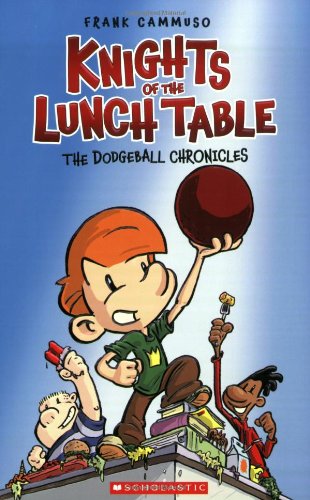
Review of Knights of the Lunch Table


This graphic novel by Frank Cammuso is a modern retelling of King Arthur appropriate for audiences 6+. This book is especially popular with boys. New student Artie King must lead a group of misfits in a dodgeball game to fight against injustice and bullying. Artie, like the King Arthur of the legends, is the unexpected hero who becomes king of the school not through violence, but through positive leadership, bravery, and teamwork. This book is simply written with engaging images and quick-moving plot. There are other books in the series if a student is interested in reading further.


EXTRA:

There are few graphic novels that can compare to the depth of Jeff Smith's Bone series or Rain Telgemeier's Smile, but Knights of the Lunch Table is rare in its old-fashioned championing of virtue, which makes it stand out in a flurry of other graphic novels that seek primarily to entertain through poor humour and excessive fighting.